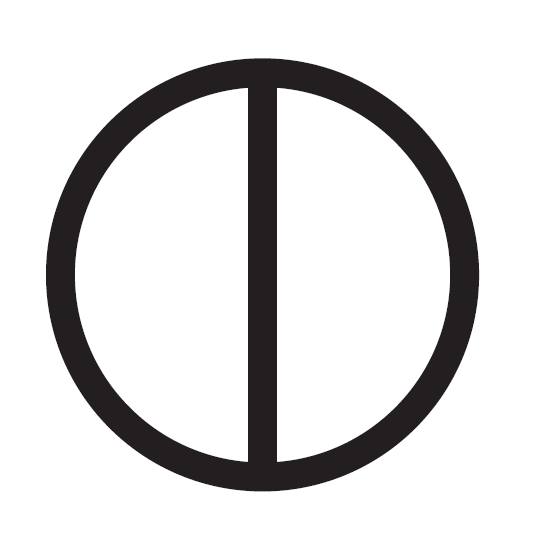
The thought occurred to me one day to write a book.
I was sitting at my desk, reading a book, acknowledging every word that was written, when I considered for an instant those words that were not. I thought that if I were to write a book, it would include not only those words that were written, but also those that were not—I had no time to be writing two separate books; one would have to have everything.
So I embarked on writing my book. I produced a pen and a blank piece of paper, and started:
But how should I have started? Where was the beginning of everything? Somewhere. Since everything would be included, everything would be reached, and the initial point did not matter. So I reasoned that the first letter—let’s say A—was as good a place to start as any. And I began:

Which was a start. But when I moved my pen to write the second letter, my initial uncertainty returned. A what? what should the second letter be? Much like the first, the second letter was mostly arbitrary, as long as I reached every other letter at some point. And since the reasoning was the same, so was the conclusion:

I didn’t need to dedicate the same amount of consideration to the following few letters, since I knew I would only repeat my reasoning. So I continued in a predictable manner:

And I waxed the string of As with confidence, as long as I remembered that at some point I would write another letter—likely it would be B, but that decision was still beyond the horizon.
So I worked on my book in that manner for about two months, a daily ordeal of adding A’s after work, and adding pages when those ran out. It was exhausting, but I was determined: either I wrote the book I wanted to write, or I wrote nothing. Although initially I had been quite liberal with my spacing, over time I began to conserve space by kerning, something like this:

Which helped preserve many more pages at the cost of no everything. I experimented more and more with such kerning, seeing how much space I could save with another shift of a millimetre, until eventually I reached a point like this:
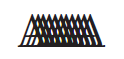
And only then did it occur to me that the way to save the most space was to simply write all the As on top of one another. I was contented with that idea, and it pleased me so much that I chose to begin anew: rather than wading through volumes of As, I would instead have them all in a single place, on a single page. I wasn’t thrilled to repeat two months of work, but I knew it was what I needed to do.
In that fashion I wrote all the As:

And was ready to move on to all the BAs, or a B followed by As, which I decided would be my next step towards everything. I reasoned that if I systematically increased all the letters in order, until I reached the last letter, Z, and then spaces, and then did the same for every lowercase letter, for every point along the string of letters, I would procedurally write everything. But first I needed to write the BAs, so without hesitation, I excitedly wrote down my first B:

But the moment I lifted my pen, I cursed myself. I had written my B next to all the As, but I was being wasteful again: there was no reason I couldn’t have written the B on top of all the As and continued to save on space. It was a little mistake, but I had already dedicated so much time to writing the book, I wanted it to be perfect, so I chose to start again. I wrote all the As again:

And this time when I wrote the B, I correctly placed it on top of the As:

And now I was ready to write all the As that would follow that B.
And so I proceeded with the entries that followed. I wrote all the BAs, the CAs that came after, and so on until I finished writing the ZAs and ultimately the _As (beginning with a space), so that eventually the time came to write the ABAs. It was by that time that my page looked so:

When I took a breath after writing the _As, I looked over what I had written, and I realised just how cluttered the occupied spot on the page had become. I had written so much, yet it was incredibly difficult to discern any letters from the result at all. That, coupled with the magnitude of having to attend to every single one of the 26 letters of the Latin alphabet, which I was using to write my book, made me begin to doubt the plausibility of my enterprise. Surely, my choice of approach couldn’t have been the most efficient means of writing the book I was looking to write.
So it was at this point, for the first time since undertaking the task, that I had chosen to step away for some time and take a break. I would revise my approach, and hopefully by the time I sat down at my desk again I would come equipped with an improved path to my desired destination. Taking time away was not the most efficient itself perhaps—each second away took me that much farther from the completion of my project—however I knew that no matter my time away, it would ultimately be negligible: the project would take an indeterminate amount of time to complete regardless, as writing everything always should.
During my time away, I researched many of the writing systems of the world, but it was only one particular one that caught my eye and attracted my interest. My initial understanding was that maybe choosing another writing system, another alphabet perhaps, would accelerate the process of writing my desired strings. But no matter which such alphabet I investigated, it was only once I had explored the world of computers and their means of recording information that I found something which promised to improve my current approach without sacrificing a single letter of the language I found so close to my heart.
In the field of computers, and mathematics too perhaps, the scientists have a system they call ‘binary’. This system serves to take any letter, say A, and give it another name strictly by numbers, those numbers being zero and one. Since A is in our case the first letter, they will call it one, and increase in counting much similarly to the means I had adopted for writing my strings of letters: incrementing one digit, and once that digit reaches its most—so one—reverting it to zero and incrementing the digit that follows. This meant that A was one—or one might even choose it to be zero to permit the absolute beginning of counting—and then B would be one; C would thus be a one followed by a zero, D two ones next to one another, and E a one followed by two zeroes. It is by such a system that one can rewrite all the letters in the Latin alphabet; and although to an untrained eye this transformation might come at the cost of some legibility, my mission from the very beginning had only ever been to write a book that contained everything, and I had already abandoned legibility some time ago.
This meant that I could much simplify my process of writing my strings of letters using only two ‘letters’ as such. Once I discovered this delightful information, I sprinted from my pleasant woodland hike right back to my desk, equipping once more my pen and presenting myself with a brand new canvas for my brilliance, discarding the old without a second thought.
With this approach I quickly regained that which I had only recently discarded, and I was making progress on the book thereon. About halfway through, the book looked so:

Having come halfway so quickly, my discovery inspired me with fresh optimism for the completion of my book, and opened up a world of new possibilities for the time scope of my project. I had originally chosen to restrict myself to only 26 letters of the alphabet, omitting any kinds of alternate characters or even punctuation in favour of the time it would take to write them as additional characters and not simply described by words, but with this new allowance for any character to be represented so simply, I had the freedom to add any symbols I wished. Not only could I write everything, I could write any particular part of that everything that much more truthfully to any point of expression—a more articulate everything, though not introducing anything novel, gave my ambition more colour.
With this most recent innovation, I felt my approach reaching a point of completeness that satisfied me, and this comfort in my decision settled me in my process, and filled my sails with wind that carried me without further hesitation to the end of my project. It was evening by the time I finished, and upon writing my final number, I let my loyal pen rest, and admired my creation:
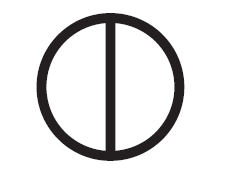
And my book was complete.
23.IX.2023
 Don't Expect Sense
Leave a comment